McKenzie County Dog Registration Information
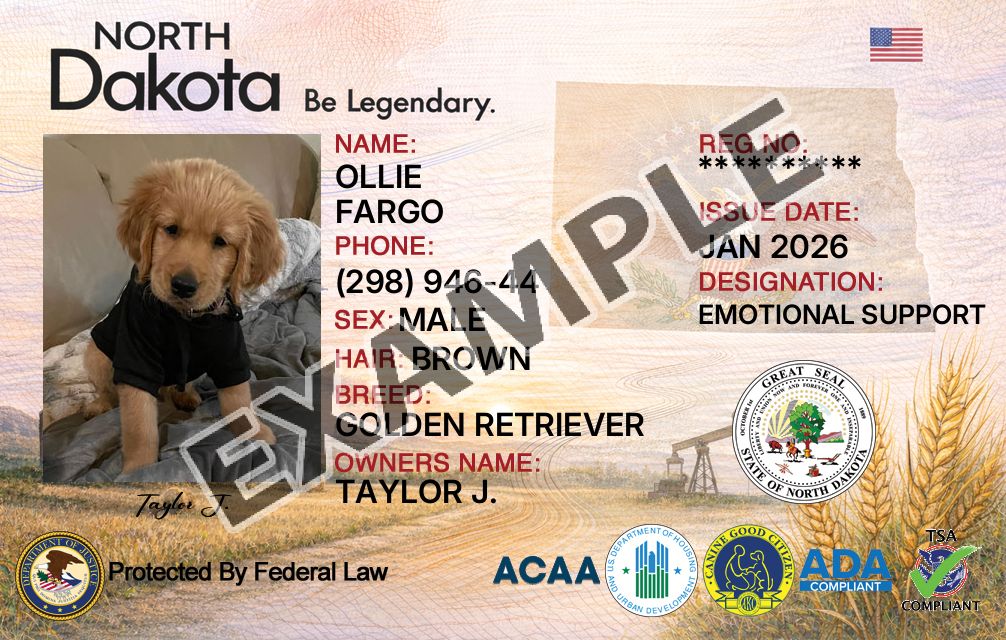
Service Dogs and Emotional Support Animals in McKenzie, North Dakota
Registering a Dog in McKenzie County, North Dakota (Service Dog or Emotional Support Dog)
If you’re searching where do I register my dog in McKenzie County, North Dakota for my service dog or emotional support dog, the most important thing to know is this: dog licensing is typically handled locally (often by a city office) and is separate from whether a dog qualifies as a service dog or an emotional support animal (ESA).
This page explains how a dog license in McKenzie County, North Dakota generally works, which official offices to contact first, what rabies documentation you may need, and what “registration” means (and does not mean) for service animals and ESAs.
Where to Register or License Your Dog in McKenzie County, North Dakota
Because licensing is commonly handled at the city level, below are several example official government offices within McKenzie County that can point you to the correct licensing process. These are good starting points if you’re trying to confirm where to register a dog in McKenzie County, North Dakota, including for a service dog or emotional support dog.
Example Local Offices (Official)
| Office | Contact & Address | Hours |
|---|---|---|
City of Watford City (City Hall / General Office)Common starting point for city licensing questions
|
Address: 213 2nd St NE, Watford City, ND 58854
Phone: (701) 444-2533
Email: Not listed on the city contact page
|
Mon–Thu: 8:00 AM – 5:00 PM
Fri: 8:00 AM – 1:00 PM
Sat–Sun: Closed
|
City of Alexander (City Hall)Good starting point for residents inside Alexander city limits
|
Address: 112 Manning Ave, Alexander, ND 58831
Phone: (701) 828-3461
Email: cityofalexander@ruggedwest.com
|
Mon–Fri: 8:00 AM – 4:00 PM (Sat–Sun closed)
|
McKenzie County Sheriff’s Office (Non‑Emergency / Dispatch)Often assists with animal-related calls and county guidance
|
Address: 1201 12th Street SE, Suite B, Watford City, ND 58854
Non‑Emergency Dispatch: (701) 444-3654
Office Phone: (701) 842-6010
|
Hours not listed on the Sheriff’s site
|
Upper Missouri District Health Unit – McKenzie CountyLocal public health contact for immunizations and rabies-related guidance
|
Address: 201 5th St NW, Suite 1100, Watford City, ND 58854
Phone: (701) 444-3449
Email: asaylor@umdhu.org
|
Tue & Thu: 9:00 AM – 4:00 PM (other days listed as closed)
|
Overview of Dog Licensing in McKenzie County, North Dakota
Dog licensing is usually local (city-by-city)
In many parts of North Dakota, there is not a single “one-stop” countywide dog licensing office for every address. Instead, the rules are often established and enforced through local ordinances (especially within city limits). That’s why the best answer to where to register a dog in McKenzie County, North Dakota depends on whether you live in a city (like Watford City or Alexander) or in an unincorporated area of the county.
Rabies vaccination is commonly tied to licensing
A dog license is typically connected to current rabies vaccination. For example, the City of Watford City has an ordinance stating a license is required for dogs (and cats) over a certain age and that a license or renewal will not be issued unless the animal has been inoculated against rabies and the owner provides proof. The same ordinance also addresses quarantine after a bite or scratch. (mcclibraryfunctions.azurewebsites.us)
“Registering” a service dog or ESA is different from licensing
Many people use “register” to mean “I need paperwork.” But legally, a dog license is a local government requirement (often for identification and rabies compliance), while service dog status comes from training and disability law, and ESA status comes from disability housing rules and documentation from a qualified professional. You can have a service dog that still needs a local license tag if your city requires it.
How Dog Licensing Works Locally in McKenzie County, North Dakota
Step 1: Identify whether you’re in city limits
Start by confirming whether your address is within a city’s boundaries. If you are, the city office is usually where you ask about the dog license in McKenzie County, North Dakota (for your specific city). If you are outside city limits, licensing may be handled differently, and you may be directed to county-level contacts for guidance.
Step 2: Ask what documentation is required (especially rabies proof)
Local licensing processes commonly require proof of current rabies vaccination (often a rabies certificate from your veterinarian). In Watford City, the ordinance language specifically requires proof in the form of a veterinarian’s certificate or affidavit showing rabies inoculation before a license or renewal is issued. (mcclibraryfunctions.azurewebsites.us)
Step 3: Ask how enforcement works (animal control, police, sheriff, or dispatch)
In smaller communities, “animal control” functions can be handled through local law enforcement or a designated city role. If you need the correct enforcement contact for a roaming dog, bite incident, or rabies quarantine questions in the county, the McKenzie County Sheriff’s Office non-emergency dispatch is a practical official starting point. (mckenziesheriff.net)
What to say when you call (script)
Use this script to get routed quickly:
- “I’m trying to confirm where to register a dog in McKenzie County, North Dakota. I live at (city / rural address).”
- “Do you issue dog licenses here, or is it handled by another office?”
- “What proof do you need—rabies certificate, ID, proof of residency?”
- “If my dog is a service dog or emotional support animal, does your local license requirement change?”
Rabies vaccination notes (public health context)
Rabies prevention is a public health issue. For bite guidance or vaccination clinic availability, local public health resources in McKenzie County can be helpful—especially when a city ordinance requires rabies inoculation and sets quarantine rules after bites or scratches. (ndcarechoice.hhs.nd.gov)
Service Dog Laws in McKenzie County, North Dakota
A service dog is defined by training and disability-related work
A service dog is not “official” because of an online registry, badge, or certificate. A service dog is generally defined by being individually trained to do specific tasks or work for a person with a disability (for example, guiding, alerting, retrieving, interrupting a medical episode, or performing mobility assistance).
Do service dogs need a local dog license?
Often, yes. A service dog may still need a local license tag if your city requires licensing for dogs within city limits. Think of it as two separate tracks: (1) local licensing (identity, rabies compliance, local ordinance) and (2) service dog legal protections (public access rights tied to disability law). If your city has a licensing ordinance linked to rabies vaccination, you should expect to provide rabies proof even if your dog is a service dog.
Public access vs. local enforcement
Service dog laws mainly address where your dog may accompany you (public places) and how businesses may interact with you. Dog licensing laws address local animal regulation. If you’re asked for a license tag by local authorities, that is typically a local compliance matter—not a “service dog registration” issue.
Emotional Support Animal Rules in McKenzie County, North Dakota
An ESA is not the same as a service dog
An emotional support animal (ESA) generally provides comfort through presence, but is not trained to perform specific disability-related tasks in the way a service dog is. Because of that, an ESA typically does not have the same public access rights as a service dog.
Housing is where ESA documentation matters most
ESA status most commonly comes up in housing. Housing providers may require reliable documentation supporting your need for an assistance animal. Even with ESA documentation, you may still need to comply with local animal rules such as vaccination requirements, leash rules, and (where applicable) a local license.
Do ESAs need a dog license in McKenzie County, North Dakota?
In many situations, yes—if your local city ordinance requires it. ESA paperwork is not the same thing as a license, and it usually does not replace rabies vaccination proof. If you’re unsure, contact your city office and ask whether your address requires a dog license in McKenzie County, North Dakota and what documentation is needed.
Frequently Asked Questions
Start with the City of Watford City office. City offices commonly manage local licensing questions, fees, and the documentation you must provide. Watford City’s ordinance specifically connects licensing/renewal with rabies inoculation proof. (cityofwatfordcity.gov)
If you’re asking “where do I register my dog in McKenzie County, North Dakota for my service dog or emotional support dog,” the answer is still typically the same local office for the license; service dog/ESA status is separate from local licensing.
For county-level help and routing (especially outside city limits), the McKenzie County Sheriff’s Office non-emergency dispatch is an official contact that can help direct you to the right process. (mckenziesheriff.net)
Commonly accepted proof includes a rabies certificate or vaccination record from a veterinarian. In Watford City, the ordinance language states the owner must provide proof in the form of a veterinarian’s certificate or affidavit showing rabies inoculation before a license or renewal is issued. (mcclibraryfunctions.azurewebsites.us)
Typically, you do not need a special county “service dog registration” to have a service dog. What you may need is a local dog license (if required where you live) and compliance with rabies rules. Service dog legal status is generally based on training and disability-related tasks—not a registry. If you want to confirm local licensing rules, contact your city office or dispatch for routing.
Usually, no. ESA documentation is generally used for housing-related accommodations. Local animal rules—like rabies vaccination requirements tied to licensing—may still apply. If you’re in Watford City, the city ordinance ties licensing to rabies inoculation proof. (mcclibraryfunctions.azurewebsites.us)
Disclaimer
Licensing requirements and office locations may change. Residents should verify details with their local animal services office within McKenzie County, North Dakota.
Register A Dog In Other North Dakota Counties
Select your county below to get started with your dog’s ID card. Requirements and license designs may vary by county, so choose your location to see the correct options and complete your pup’s registration.
- Adams County Dog Registration
- Barnes County Dog Registration
- Benson County Dog Registration
- Billings County Dog Registration
- Bottineau County Dog Registration
- Bowman County Dog Registration
- Burke County Dog Registration
- Burleigh County Dog Registration
- Cass County Dog Registration
- Cavalier County Dog Registration
- Dickey County Dog Registration
- Divide County Dog Registration
- Dunn County Dog Registration
- Eddy County Dog Registration
- Emmons County Dog Registration
- Foster County Dog Registration
- Golden Valley County Dog Registration
- Grand Forks County Dog Registration
- Grant County Dog Registration
- Griggs County Dog Registration
- Hettinger County Dog Registration
- Kidder County Dog Registration
- LaMoure County Dog Registration
- Logan County Dog Registration
- McHenry County Dog Registration
- McIntosh County Dog Registration
- McLean County Dog Registration
- Mercer County Dog Registration
- Morton County Dog Registration
- Mountrail County Dog Registration
- Nelson County Dog Registration
- Oliver County Dog Registration
- Pembina County Dog Registration
- Pierce County Dog Registration
- Ramsey County Dog Registration
- Ransom County Dog Registration
- Renville County Dog Registration
- Richland County Dog Registration
- Rolette County Dog Registration
- Sargent County Dog Registration
- Sheridan County Dog Registration
- Sioux County Dog Registration
- Slope County Dog Registration
- Stark County Dog Registration
- Steele County Dog Registration
- Stutsman County Dog Registration
- Towner County Dog Registration
- Traill County Dog Registration
- Walsh County Dog Registration
- Ward County Dog Registration
- Wells County Dog Registration
- Williams County Dog Registration